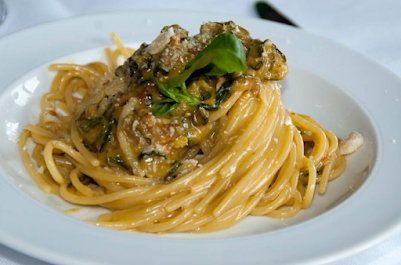
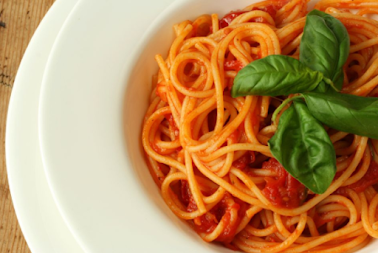
Spaghetti Nerano is a favorite Pasta of Sorrento and The Amalfi Coast of Italy. It's a simply pasta made with Zucchini fried in Italian Olive Oil, and mixed with Spaghetti, some pasta cooking water, and grated cheese. The most popular cheese is local Caciocavallo Cheese from Campani, but Pecorino, and or Grana Padano, or Parmigiano Reggiano are used also, hwatever you have, just make sure that is good quality cheese as the cheese is what gives the dish much of its flavor.
This dish has become very popular, especailly with the insame interest in Positano, and the Amalfi Coast as one of the World's top vacation destinations and with the popularity of Stanley Tucci's popular Italian Food and Travel TV Show "Searching For Italy" on CNN.
Spaghetti Nerano was invented by Maria Grazia in the 1950s at her Trattoria in the town of Nerano
near Sorrento, Italy. The dish is served on Capri, in Sorrento, and all over the Amalfi Coast.
It can be hard to remember, but coffee isn’t just a delicious liquid drug — at its most basic level, it’s a plant that people sow, grow, and harvest. There are plenty of kinds of coffee, too, and none as significant on the global market as coffee canephora, also known as robusta. That’s one of the hardiest, most caffeinated varieties of coffee. And while its counterpart arabica gets more attention for having a wider flavor profile, robusta is far less likely to be classified as “specialty” coffee. Both kinds’ global popularity is thanks to Europe’s carving up of coffee-growing regions such as East Africa and Southeast Asia for export: The Dutch taking coffee to Indonesia and enslaving locals is how we got the now-common term “java,” for example.
Political theorist Carl Schmitt called such adventures in mercantilism the beginning of the “Eurocentric nomos of the Earth” — he’d know, given his support of the Nazi party. Thanks to coloniality, numerous commodities like coffee became associated with Europe. In brief, naval travel and military technology allowed Spanish, Portuguese, and Dutch conquerors to leverage the addictive crop as one more line item in a growing global ledger. Propaganda supported the expansion. There was Edwin Lester Linden Arnold’s handbook for coffee growing in 1886, published one year after the Berlin Conference began cutting up Africa into new districts, and J.W.B. Money’s Java; or, How to Manage a Colony. Both treat the people harvesting large-commodity crops including coffee as inferior, which means coffee and subjugation go hand in hand.
The next generation of imperialists including the young United States took to these lessons and examples to enslave people the world over for their own sugar, spice, tea, and coffee. Take the Belgians’ colonization of the Congo in the late 1800s, a premier region for rubber and robusta coffee. It was the Belgians who named robusta coffee as such due to its “robust” resilience to pestilence. Locals were worked to death, often from exhaustion but also from acts of violence at the hands of Belgian exporters and guards. And, as Adam Hochschild writes in King Leopold’s Ghost, Africans were not to be paid in francs for their labor, instead receiving cloth, beads, and brass rods. “Money in free circulation might undermine what was essentially a command economy,” Hochschild writes.
The impacts of these actions live on. Burundi — also colonized by Europe — is today one of, if not the, poorest country in the world and depends heavily on coffee exports. According to Standart magazine, the government tightly controls seed allowances, pays farmers only once or twice a year, and mandates that farmers sell their coffee as a low-grade commodity rather than a specialty. Vietnam, which has suffered numerous invasions over generations, is the second-largest coffee producer behind Brazil. And El Salvador’s political unrest and civil war in the 1980s can be traced back to the early occupation of coffee barons, including James Hill, an English businessman who became one of the country’s most infamous coffee oligarchs.
Mickey's Diner
MINNESOTA
No matter the ruination, the United States was eager for coffee to become part of its social fabric from the jump, and ingrained it has become. There’s evidence that suggests that coffee came to the East Coast in 1607 with English captain John Smith, and the drink became a backbone of the young new empire. A few centuries later, around the middle of the 20th century, the coffee break became a thing thanks to a greedy tie factory owner in Denver. In 1962, the International Coffee Agreements was established — actually a stabilizing move thanks to mandatory quotas on coffee imports — only to be blown up in 1989 amid market share disputes among producers and changing consumer tastes. Through it all, coffee burrowed deeper and deeper into the United States’ psyche.
Which is to say, diner coffee is, really, the improbable marriage of low prices and a hungry market. According to the Smithsonian Magazine, the first attempt at a diner came from Providence, Rhode Island, in 1872 in the form of a horse-drawn wagon serving cheap, hot food to people looking for late-night eats. And by 1924, the name for the “rolling restaurants” and “dining cars” became shortened to diner. As these casual restaurants multiplied (long before anything was even considered “ethical” or “fair trade certified”), coffee emerged as a cheap, on-demand menu staple. That coffee became part and parcel of Americana is thanks to these historical events, the rise of restaurants in the country writ large, and, of course, public relations. See: Denny’s partnership with Major League Baseball, chimerically combining the dark elixir, baseball, and Americana on color TV.
With the rise of Equal Exchange and fair trade certification in the 1980s and the proliferation of coffee chains around the world that have fueled consumer tastes for ever-higher quality products, coffee is continuing to evolve. As of 2023, Fairtrade International upped its minimum purchase per pound for certified coffee to $1.80, coffee workers at Starbucks and Peet’s locations throughout the country are unionizing for better pay and conditions, and fourth-wave coffee, with all of its possibilities, is either just over the horizon or already here (depending on whom you ask). But diner coffee, and the low-quality sourcing and methods used in its production, falls well outside of all that progress. It’s a relic in time, an artifact of an America not unlike the restaurants it’s poured in that are still somehow super cheap.
In truth, diner coffee can’t really change. There’s virtually no demand for that coffee to taste better, and supply for the commodity-grade staple is as abundant (for now) as it is unethical. As Michael Pollan might prescribe, drink coffee you can trace, drink only as much as you can afford to buy that is thoughtfully sourced, and buy mostly from small and direct-purchasing farms. But as the botanist also concedes, sometimes you still crave an Oreo.
The BENDIX DINER
Hasbouk Heights, New Jersey
On a spring afternoon in Sedona, Arizona, the Coffee Pot Restaurant is somehow as busy as many diners would hope to be during the morning rush. Servers in bright red T-shirts and aprons chat beneath southwestern motifs and rockscape paintings. Hiking through Red Rock State Park just outside of town can really sap your energy. So while there are vortexes that might refill that void, a damn fine cup of coffee also does the job.
But for all the health-focused marketing throughout the touristy town, Sedona hosts more places to get your aura photo taken than cafes with transparently sourced, fairly purchased coffee. So, Coffee Pot’s $3.75 cup of coffee will have to do.
No, it isn’t good for the planet. Or, most likely, for workers. But when there’s nothing much better around, and when the nostalgia hits, a cup of jet-black, bitter diner coffee remains an affordable, bottomless delight.
Seventy years since coronation chicken was created for the Queen’s ascension to the throne, a new royally-approved dish has been announced to mark King Charles III’s coronation. The official recipe is (drum roll please)… a quiche.
Personally selected by the King alongside Camilla, the Queen Consort, it’s hoped that the dish will be created for street parties across the country on 6 May, when Charles is officially being crowned. The recipe, which you can find below, is described as a ‘deep quiche with a crisp, light pastry case and delicate flavours of spinach, broad beans and fresh tarragon.’ It was created by royal chef Mark Flanagan, who recommends we enjoy it alongside a green salad and boiled new potatoes.
The CORONATION QUICHE
So why quiche, you might wonder? Granted, the dish might not scream trendy, but it was picked because it’s a good sharing option, can be served hot or cold, is not too complicated or expensive to make, and can be adapted for different dietary requirements. It’s significant that the King picked a vegetarian dish too, as he is known for his commitment to environmental issues, and has previously spoken about the impact of meat consumption.
Quiche is often thought of as a French dish, but it’s actually believed to have originated in Germany, in the medieval kingdom of Lothringen – later occupied by the French, who renamed it Lorraine. The original quiche was a pie filled with egg and cream custard, and cheese was later added to the mix. Originally, the base was made from bread dough, but that changed over the years and now it’s typically made from a short-crust or puff pastry crust.
It became popular in England following the Second World War, after British troops returned and shared the recipe with their hometowns. A traditional quiche Lorraine includes bacon or ham, but the opportunities are endless when it comes to fillings.
CAMILA & KING CHARLES
Recipe: Coronation Quiche
Serves 6
Ingredients
Pastry
4 ounces plain Flour
Pinch of salt
1 ouncecold butter, diced
1 ounce lard
2 tablespoons milk
Or 1 ready-made shortcrust pastry
Filling
4 ounces Whole Milk
6 ounces double cream
2 medium eggs
1 tablespoon chopped fresh tarragon
Salt and pepper
4 ounces grated cheddar cheese
6 ounces cooked spinach, lightly chopped
3 ounces cooked broad beans or soya beans
Method
To make the pastry…
Sieve the flour and salt into a bowl; add the fats and rub the mixture together using your finger tips until you get a sandy, breadcrumb like texture.
Add the milk a little at a time and bring the ingredients together into a dough.
Cover and allow to rest in the fridge for 30-45 minutes
To make the quiche…
Lightly flour the work surface and roll out the pastry to a circle a little larger than the top of the tin and approximately 5mm thick.
Line the tin with the pastry, taking care not to have any holes or the mixture could leak. Cover and rest for a further 30 minutes in the fridge.
Preheat the oven to 190°C.
Line the pastry case with greaseproof paper, add baking beans and bake blind for 15 minutes, before removing the greaseproof paper and baking beans.
Reduce the oven temperature to 160°C.
Beat together the milk, cream, eggs, herbs and seasoning.
Scatter 1/2 of the grated cheese in the blind-baked base, top with the chopped spinach and beans and herbs, then pour over the liquid mixture.
If required gently give the mixture a delicate stir to ensure the filling is evenly dispersed but be careful not to damage the pastry case.
Sprinkle over the remaining cheese. Place into the oven and bake for 20-25 minutes until set and lightly golden.
• 4 - 28oz cans high quality tomato puree or whole tomatoes, crushed by hand⠀
• 1/2 can water⠀
• 1 ½ tsp salt (or to taste)⠀
• ½ tsp black pepper⠀
• 1 ½ Tbsp dried oregano ⠀
• big handful fresh basil, whole or torn by hands⠀
⠀
⠀
• In a heavy-bottomed saucepan, heat the olive oil and the onions together on medium-high heat and sauté until the onions are soft and beginning to brown slightly.⠀
• Add the garlic and continue to sauté until the garlic is soft.⠀
• Add the next 3 ingredients and sauté for 2 minutes, to release the flavors of the herbs, while stirring.
⠀
• Add the next 5 ingredients and bring to a light boil, then immediately reduce heat to a low simmer. Simmer for about 45-60 minutes. Adjust seasoning if necessary.⠀
• Remove from heat and stir in the second amount of basil and the marinara is ready to go!